

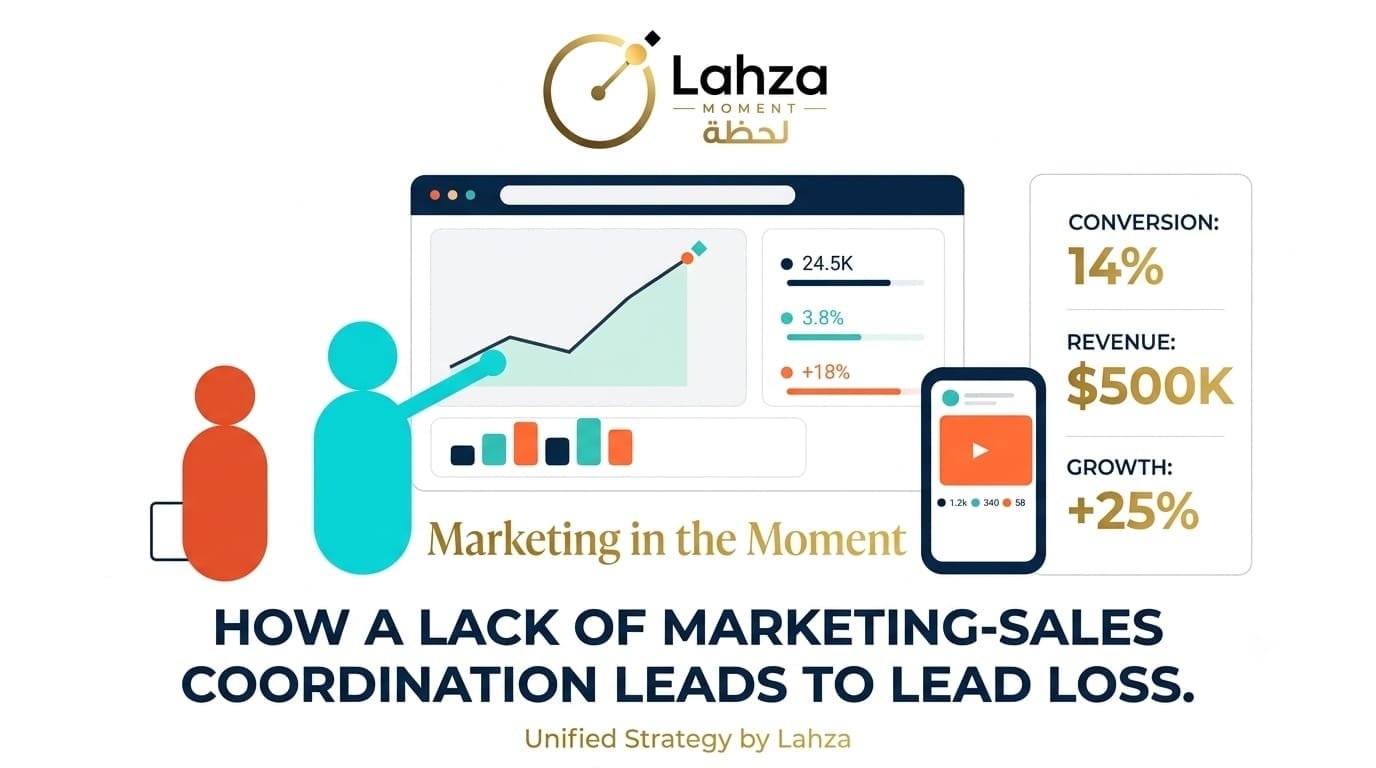
How Does Poor Alignment Between Marketing and Sales Lead to Losing Customers?
A company may invest a significant budget in digital marketing, advertising, and content creation, successfully generate a large number of leads, and still fail to achieve the expected sales results.
In many cases, the problem is not the quality of the product or the performance of the advertising campaigns. Instead, it may be caused by a gap between the marketing and sales teams.
When marketing and sales operate separately, customer data may be lost, follow-ups may be delayed, and customers may reach the purchasing stage without a clear and organized experience. This can increase the likelihood of losing them.
Therefore, marketing and sales alignment is not simply an internal management improvement. It is an essential part of attracting customers, converting leads into customers, and maintaining long-term customer relationships.
What Does Marketing and Sales Alignment Mean?
Marketing and sales alignment means having a clear process for cooperation between both teams, starting from the moment a potential customer is attracted until the sale is completed and beyond.
Marketing focuses on:
- Reaching the target audience.
- Building brand awareness.
- Generating leads.
- Creating relevant content.
- Running advertising campaigns.
- Collecting lead data.
Sales focuses on:
- Communicating with potential customers.
- Understanding customer needs.
- Answering questions and inquiries.
- Evaluating the customer’s readiness to buy.
- Following up on sales opportunities.
- Converting qualified leads into customers.
The problem begins when there is no clear connection between these stages.
1. Losing Leads After They Reach the Company
An advertising campaign may generate dozens or even hundreds of leads, but generating a lead does not necessarily mean generating a sale.
If there is no clear system for receiving and following up with leads, several problems may occur:
- Delayed communication with the customer.
- Lack of information about where the lead came from.
- Loss of important customer data.
- No clear person responsible for follow-up.
- No organized record of previous communication.
As a result, the money spent on Lead Generation may not translate into real sales opportunities.
2. Delayed Follow-Up May Push Customers Toward Competitors
A potential customer who sends an inquiry or requests a quotation may already be comparing several companies.
If a competitor provides a fast and organized response while your company delays contacting the customer, the customer’s attention may shift toward the available alternative.
This highlights the importance of connecting marketing and sales, so that leads are transferred to the sales team quickly, along with the information the team needs to begin the follow-up process.
3. Attracting the Wrong Type of Customers
The marketing team may measure its success based on the number of leads generated, while the sales team focuses on the quality of those leads and their likelihood of making a purchase.
If both teams do not agree on a clear definition of a qualified lead, the company may generate a large number of leads, while only a small percentage are actually suitable for the product or service.
Therefore, it is not enough to measure:
The number of leads
Companies should also consider:
Lead Quality → Qualified Leads → Sales Opportunities → Actual Sales
4. Inconsistent Messaging Between Advertising and Sales
One of the problems that can negatively affect the customer experience is seeing one message in an advertisement and receiving different information when communicating with the sales team.
For example, if an advertisement focuses on a specific feature or offer, but the sales team is not aware of its details or conditions, the customer may experience confusion or inconsistency.
For this reason, marketing messages and the information used by the sales team should remain as consistent as possible.
5. Marketing May Not Know Why Deals Are Being Lost
The sales team communicates directly with customers and therefore has valuable information about why purchases are not completed.
A customer may decide not to purchase because of:
- Price.
- Lack of clarity about the service.
- A specific objection.
- The product not meeting their needs.
- A competitor offering a different proposition.
- Poor timing.
If this information does not reach the marketing team, campaigns may continue targeting the audience in the same way without benefiting from the insights collected by sales.
6. Marketing May Continue Attracting the Wrong Leads
When marketing does not receive real data from sales, it becomes difficult to determine which leads actually turn into customers.
The company may continue spending money on sources or campaigns that generate a large number of leads, even though their conversion rate is low.
With proper alignment, the company can analyze lead sources and determine:
Which campaign?
Which channel?
Which audience?
Which type of content?
is most closely connected to sales opportunities and actual customers.
7. Lack of a Clear CRM System
CRM is one of the most important tools for connecting marketing and sales.
A Customer Relationship Management system can help companies organize information such as:
- Lead source.
- Contact information.
- The advertisements or campaigns that generated the lead.
- Customer journey stages.
- Call and follow-up history.
- Sales opportunity status.
- Reason for a lost deal.
- Next follow-up date.
This prevents customer information from being scattered across messages, spreadsheets, and different files.
8. Losing Customers Due to Weak Follow-Up
Not every customer is ready to buy immediately.
Some customers may need:
- More information.
- Time to compare options.
- Pricing details.
- To speak with a representative.
- More time to make a decision.
If a company treats an immediate lack of purchase as the end of the relationship, it may lose customers who could potentially convert in the future.
This is where Lead Nurturing becomes important: following up with leads in an organized way based on their stage in the customer journey and their interests.
9. No Agreement on Sales Funnel Stages
It is important for both marketing and sales teams to understand where the customer is within the Sales Funnel.
For example, the customer journey may include:
Brand Awareness → Traffic → Engagement → Lead Generation → Lead Qualification → Lead Nurturing → Sales Opportunity → Purchase → Customer Retention
If these stages are not clearly defined, the sales team may treat every lead in the same way, even though customers have different levels of purchase readiness.
10. Higher Customer Acquisition Costs
When a sufficient percentage of leads do not convert into actual customers, the Customer Acquisition Cost (CAC) can increase.
If a company spends money on advertising to attract customers but loses a significant percentage of them because of poor follow-up or internal misalignment, the cost of acquiring each actual customer becomes higher.
Improving marketing and sales alignment can therefore help companies make better use of the budget they are already investing in customer acquisition.
How Can Companies Improve Marketing and Sales Alignment?
Companies can build a more organized process through several steps:
1. Define the Target Customer
Both teams should agree on the characteristics of the target customer, their needs, problems, and the factors that influence their purchasing decisions.
2. Define the Qualified Lead
Not every lead is necessarily a sales opportunity.
Companies should establish clear criteria for determining when a lead should move from marketing to sales.
3. Create a Clear Lead Handoff Process
The sales team should know when and how to receive a lead and what information should be available to them.
4. Use a CRM System
A CRM system helps collect customer data, organize follow-up stages, and monitor sales opportunities.
5. Share Sales Feedback With Marketing
Sales insights should continuously reach the marketing team, especially information about customer objections, frequently asked questions, and reasons for rejecting an offer.
6. Measure Shared Results
Instead of focusing only on the number of leads, companies can monitor metrics such as:
- Number of leads.
- Lead quality.
- Lead-to-opportunity conversion rate.
- Customer conversion rate.
- Customer Acquisition Cost (CAC).
- Sales Pipeline value.
- Deal closing rate.
- Revenue.
- Return on Ad Spend (ROAS).
Why Do Companies Need Marketing & Sales Alignment?
The customer journey does not begin when the sales team contacts the customer, and it does not end when an advertisement is launched.
Customers typically move through several stages, starting with brand awareness, followed by research and comparison, engagement, communication, and eventually a purchasing decision.
The more connected these stages are, the easier it becomes for a company to understand customers, follow up with them, and improve their overall experience.
When marketing and sales operate as completely separate functions, gaps can emerge that lead to:
Lost Leads → Weak Follow-Up → Lower Conversion → Higher Customer Acquisition Cost → Lost Sales Opportunities
Marketing Attracts the Customer. Sales Converts Them Into a Customer.
Marketing and sales should not operate as completely separate functions. Instead, they represent connected stages within the customer acquisition process.
Marketing helps reach the right audience, attract attention, and generate leads.
Sales works to understand customer needs, qualify leads, follow up with prospects, and convert suitable opportunities into purchases.
When these two stages are connected through a clear strategy, CRM, shared data, and an organized follow-up process, companies become better equipped to understand the customer journey and improve customer acquisition.
Conclusion
Poor alignment between marketing and sales can lead to more than declining sales. It can result in lost leads, inefficient use of advertising budgets, higher customer acquisition costs, and the loss of valuable information about customers and the market.
Building an integrated system that combines Digital Marketing, Lead Generation, CRM, and Sales can help businesses turn their marketing efforts into sales opportunities in a more organized and effective way.
Make Your Moment Count with Lahza
If your product or service deserves to be seen by the world… this is your moment. ✨
Your opportunity for a free consultation starts now.
Lahza Marketing — Marketing Services for Everyone.
We Reach Your Customers in an Instant.
We help you build a real digital presence and reach your target audience through digital marketing, advertising, content creation, social media management, and improving your online visibility.
📞 Contact us:
01080858690
01035606505
WhatsApp