

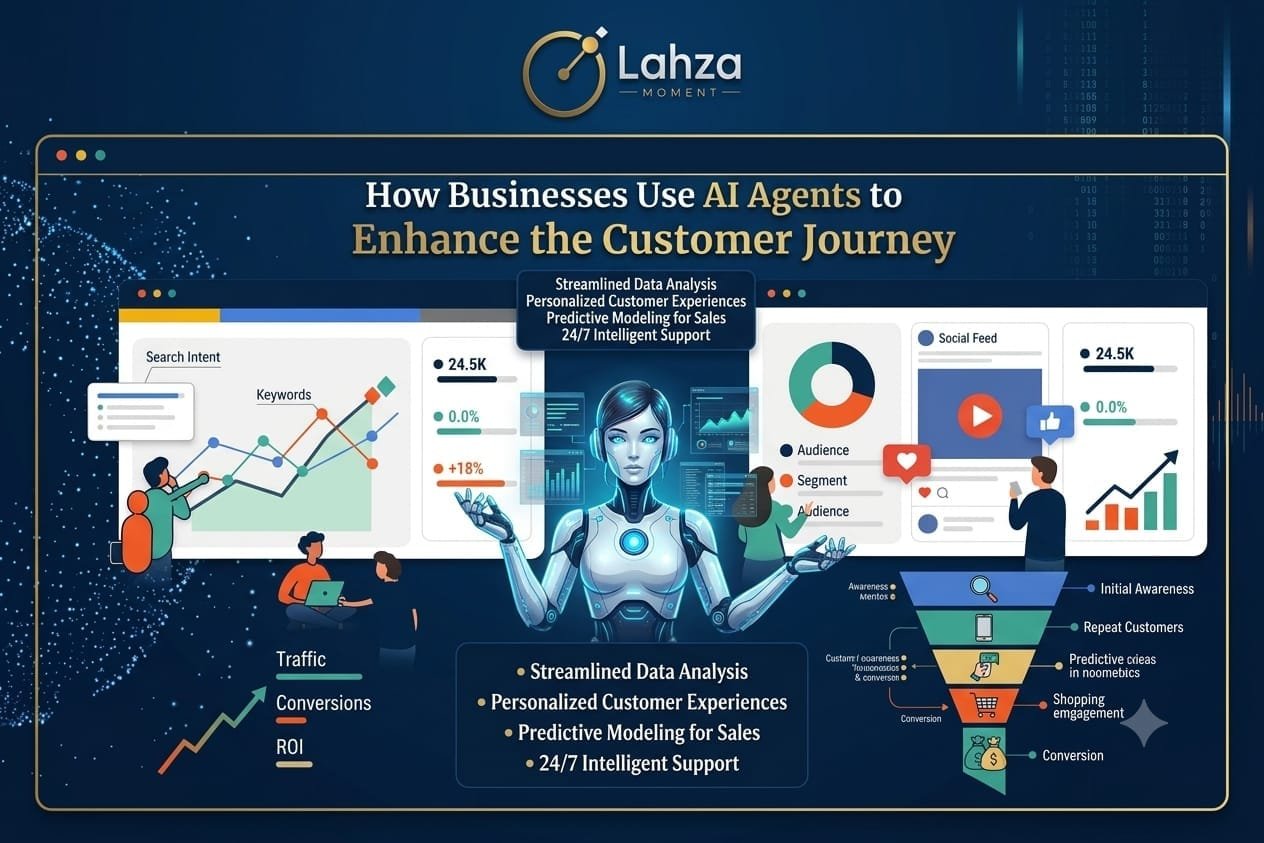
How Do Companies Use AI Agents to Improve the Customer Journey in Marketing?
The customer journey in marketing is no longer simply a fixed sequence that starts with an advertisement and ends with a purchase. With the development of Artificial Intelligence and AI Agents, companies can now analyze customer behavior, understand customer needs, personalize marketing messages, and automate many actions across different stages of the customer journey.
Unlike traditional AI tools, AI Agents can perform multiple steps and tasks related to a specific objective rather than simply generating content or providing an answer. These agents can also be integrated with systems such as CRM platforms, marketing platforms, websites, and customer service tools to create more connected processes.
This creates new opportunities for businesses to build more responsive and personalized customer experiences while maintaining human involvement in strategy, supervision, and sensitive decision-making.
What Are AI Agents in Marketing?
AI Agents, or artificial intelligence agents, are systems that use generative AI, analytical capabilities, and decision-making processes to perform multiple tasks toward a specific objective while interacting with data, tools, and different business systems.
In Digital Marketing, AI Agents can be used for tasks such as:
- Analyzing customer data.
- Segmenting audiences.
- Personalizing content and messages.
- Analyzing advertising campaign performance.
- Qualifying leads.
- Following up with potential customers.
- Recommending the next step in the customer journey.
- Automating certain marketing processes.
- Connecting marketing data with sales and customer service.
The importance of this technology comes from its ability to work across multiple connected steps rather than performing only one isolated task.
What Is the Customer Journey in Marketing?
The Customer Journey refers to the stages a customer goes through from discovering a brand to making a purchase. It may continue after the purchase through customer support, engagement, and retention.
The customer journey may include:
Awareness → Consideration → Engagement → Lead Generation → Qualification → Purchase → Retention
Not all customers follow the same journey or move through these stages at the same speed.
This is where AI Agents can play an important role by monitoring customer interactions and behavioral signals and coordinating relevant actions across different stages instead of relying on one fixed journey for everyone.
1. Analyzing Customer Behavior and Understanding Their Needs
Companies can use AI Agents to analyze large amounts of data related to customer interactions, such as:
- Pages customers visit.
- Products or services they are interested in.
- Content engagement.
- Lead sources.
- Communication history.
- Sales Funnel stages.
- Previous customer interactions.
This analysis can help companies build a more complete understanding of customers instead of relying on disconnected data from individual channels.
It can help answer questions such as:
What is the customer looking for?
What attracted their attention?
Where are they in the buying journey?
What should the next action be?
2. Personalizing the Customer Experience
Personalization has become one of the most important trends in Digital Marketing.
Instead of sending the same message to every customer, companies can use AI Agents to help personalize:
- Content.
- Offers.
- Email messages.
- Advertisements.
- Product recommendations.
- Follow-up messages.
- Website experiences.
AI can use customer context and available data to help determine which content, offers, and experiences are more relevant to different customers.
3. Improving Lead Generation
AI Agents can help companies improve Lead Generation instead of focusing only on generating the largest possible number of leads.
For example, an AI system can analyze lead sources and identify:
- Which channels generate leads.
- Which audiences show the highest engagement.
- Which content generates greater interest.
- Which pages achieve better conversion rates.
- Which signals indicate strong customer interest.
This allows marketing teams to move from focusing only on the number of leads to focusing on lead quality and conversion opportunities.
4. Lead Qualification
Not every lead is ready to make a purchase.
AI Agents can help analyze available customer data and classify leads according to criteria defined by the company.
For example:
New Lead → Interested Lead → Qualified Lead → Sales Opportunity
This process can be connected to a CRM system, allowing information to be transferred to the sales team when a customer reaches a specific stage.
This type of integration can reduce manual work and improve the process of transferring leads from marketing to sales.
5. Lead Nurturing
A customer may not be ready to purchase during their first interaction.
This is where AI Agents can support Lead Nurturing processes based on the customer’s stage and interests.
Instead of sending the same message to everyone, the system can help determine:
- When to follow up.
- What content is appropriate.
- What information the customer needs.
- When the customer should be transferred to the sales team.
- When human intervention is required.
Marketing and sales automation are among the areas where AI applications continue to expand.
6. Improving the Website Customer Experience
AI Agents can be integrated with websites to assist customers while they browse.
For example, an AI Agent can help with:
- Answering questions.
- Directing customers to the right page.
- Explaining products or services.
- Helping customers find relevant information.
- Collecting lead information.
- Routing relevant inquiries to the sales team.
The goal, however, is not simply to add a Chatbot to a website. The goal is to connect customer interactions with relevant data and business processes so that the customer does not have to restart their journey at every touchpoint.
7. Improving Advertising Campaigns
AI Agents can be used in processes related to advertising campaigns, including performance analysis, idea testing, and identifying optimization opportunities.
In more advanced environments, AI systems can help coordinate decisions related to audiences, content, and budgets across different stages of a campaign.
Agentic AI can support continuous marketing processes that include data analysis, content creation, personalization, and coordination across different parts of the marketing ecosystem.
However, this does not mean that advertising decisions should be left entirely to AI. Goals, boundaries, and human oversight remain important elements of responsible AI use.
8. Connecting Marketing and Sales Through CRM
One of the potential advantages of AI Agents is their ability to work across different systems.
When a company has a CRM containing customer data, AI Agents can be integrated with marketing and sales processes to help teams understand:
- Customer source.
- Previous interactions.
- Products or services they are interested in.
- Sales Funnel stage.
- The most recent action taken.
- The recommended next step.
This makes customer data more connected to the customer journey instead of remaining scattered across marketing, sales, and customer service teams.
9. Recommending the Next Best Action
One important use of AI in the customer journey is identifying the Next Best Action, meaning the most appropriate next step based on the available customer data.
For example, the next action could be:
- Sending educational content.
- Providing additional information.
- Contacting the customer.
- Recommending a related product.
- Reminding the customer about an incomplete request.
- Transferring the customer to the sales team.
- Requesting intervention from a specialized employee.
The goal is not for AI to make every decision independently. Instead, AI can help businesses use customer data to determine the next action in a way that better responds to customer behavior.
10. Improving Customer Retention
The customer journey does not end after a purchase.
AI Agents can monitor post-purchase engagement signals and help identify opportunities such as:
- Declining engagement.
- Customer support needs.
- Upselling opportunities.
- Cross-selling opportunities.
- The need for educational content.
- Potential churn indicators.
AI can increasingly support customer experiences across the entire customer lifecycle, including customer retention and post-purchase growth.
How Do AI Agents Work Across the Customer Journey?
The process can be visualized as follows:
Awareness
↓
Audience analysis and customer targeting
Engagement
↓
Content personalization and interaction
Lead Generation
↓
Collecting lead information
Lead Qualification
↓
Analyzing and qualifying leads
Lead Nurturing
↓
Following up with relevant content and messages
Sales Opportunity
↓
Connecting the customer with the sales team
Purchase
↓
Improving the purchasing experience
Retention
↓
Following up with the customer and personalizing the post-purchase experience
This is where AI Agents can become more than an isolated tool and instead become part of a broader Marketing Automation and Customer Experience ecosystem.
What Is the Difference Between a Chatbot and an AI Agent in Marketing?
It is important to understand the difference between these two concepts.
A Chatbot typically focuses on conversations and answering user questions within a defined scope.
An AI Agent, on the other hand, can be designed to achieve a specific objective and execute a series of actions using available data, tools, and business systems.
For example:
Chatbot:
“What is the price of the service?”
AI Agent:
The AI Agent understands the customer’s context, searches available information, identifies the relevant service, asks qualification questions, records the information in the CRM, and then directs the customer to the appropriate next step according to predefined rules.
The level of autonomy depends on how the system is designed and what permissions are given to the AI Agent.
Can AI Agents Replace Marketing Teams?
This is not the primary purpose of AI Agents.
The greatest value often comes from clearly distributing responsibilities:
AI Agents:
Data analysis, repetitive task execution, automation, personalization, follow-up, and coordination across certain processes.
Marketing Team:
Strategy, creativity, brand identity, market understanding, decision-making, and brand management.
Sales Team:
Customer relationships, negotiation, understanding customer needs, and closing deals.
A hybrid model that combines human expertise with AI can allow AI Agents to handle certain execution and coordination tasks while people remain responsible for strategy, oversight, and important decisions.
What Do Companies Need Before Implementing AI Agents?
Companies should not start with the technology itself. They should start by identifying the problem they want to solve.
Several factors should be considered:
1. Define the Objective
Is the goal to:
- Generate more leads?
- Improve conversion?
- Reduce follow-up time?
- Improve customer service?
- Increase customer retention?
2. Prepare the Data
AI Agents require organized and reliable data to produce useful results.
3. Integrate the Systems
The ecosystem may need integration with:
- CRM.
- Website.
- Email Marketing.
- Advertising Platforms.
- Customer Service.
- Analytics Tools.
4. Define Permissions and Boundaries
Companies should determine what the AI Agent can do independently and which actions require human approval.
5. Measure Performance
Businesses should define clear performance indicators such as:
- Conversion Rate.
- Lead Quality.
- Customer Acquisition Cost.
- Customer Retention.
- Response Time.
- Sales Conversion.
- Marketing ROI.
Risks of Using AI Agents in Marketing
Although AI Agents create significant opportunities, their implementation requires proper planning and governance.
Key challenges include:
- Data quality.
- Customer privacy and data protection.
- Output accuracy.
- Consistency with brand identity.
- Inappropriate decisions.
- Poor system integration.
- Over-reliance on automation.
- The need for clear human oversight.
Adding AI to fragmented processes without redesigning the underlying workflow may not solve the original problems. It can potentially scale existing weaknesses instead.
For this reason, processes, data, permissions, and human oversight should be designed alongside the technology, rather than simply adding AI to an unorganized system.
The Future of AI Agents in Digital Marketing
Digital marketing is gradually moving from isolated campaigns toward more connected systems based on data, automation, and personalization.
Instead of each tool operating independently, different systems can work together across the customer journey:
Marketing → Lead Generation → CRM → Sales → Customer Service → Retention
This means the future of Digital Marketing will not depend only on producing more content or launching more advertising campaigns. It will also depend on a company’s ability to understand customers, use data effectively, and coordinate the right actions at the right time.
Agentic AI may become an increasingly important part of redesigning marketing processes, particularly in personalization, data analysis, content creation, campaign optimization, and customer journey coordination.
However, the actual value depends on the quality of implementation, data, and governance—not simply on adopting the technology.
Conclusion
AI Agents can help companies improve the customer journey by analyzing data, personalizing customer experiences, improving Lead Generation, qualifying leads, automating follow-ups, connecting marketing with sales, and supporting customer retention.
However, the real value does not come from using AI simply for the sake of using it. It comes from integrating AI into a clear Digital Marketing strategy, organized processes, reliable data, and appropriate human oversight.
When AI Agents + CRM + Marketing Automation + Digital Marketing work together, businesses can create a more connected and responsive customer experience across different stages of the buying journey.
At Lahza
We turn your idea into a real digital presence and put your product or service in the spotlight it deserves through marketing, advertising, and content creation.
Let your moment of visibility begin now.
📞 Contact us:
01080858690
01035606505
WhatsApp